Monday, September 19, 2011

PAUPER’S LOG: Mehangai Dayan


THE LIGHT OF ANDAMANS | ISSUE 12 | 16 SEPTEMBER 2011


PAUPER’S LOG:
Mehangai Dayan

By Abu Arsh

Sakhi Saiyan to khube kamat hai
mehangai dayan khaye jaat hai 
har mahina uchhle petrol
deisal ka uchhla hai role
Sakkar bhai ke ka bol
Roosa baat maati dhaan hamari jaan hai
Mehngai dayan khayat jaat hai.......


This quirky song from off-beat movie 'Peepli Live' is a funny satirical folk song on rising prices reflecting state of affairs in most of our day to day life. State-run oil companies last week raised the price of petrol by Rs 3.14 per litre, the third substantial increase since January 2011, a move which is expected to stoke inflation and upset household budgets. As per BJP, the Congress-led government has increased petrol prices ten times in just a year. The opposition alleged that UPA-II, under economist Prime Minister Manmohan Singh, has increased the price of petrol by a total of Rs 25 since it took office. According to media reports - consumers feel the increase was unjustified and imposed a fresh burden. It is becoming unbearable and how can the common man face such sharp increase. It will add to already high expenses. A day after a Rs 3 a litre rise in the price of petrol, the UPA government was forced by its allies to postpone 16.09.2011 scheduled meeting to discuss capping the sale of subsidised cooking gas (LPG) cylinders. The petroleum ministry has suggested a phased capping of subsidised LPG cylinders, while putting in a mechanism for direct transfer of subsidy to the intended beneficiaries. Under this, consumers will have to buy cylinders above the proposed annual quota of four to six at the market price
Who are these consumers affected by the 'unjustified' petrol price hike? Who is this 'common man'?
The middle class does not like to pay more for petrol, much as it does not, inexplicably, like to pay more for onions and potatoes. It's not the poor - they cannot afford the basic necessities. It's not the rich - no price rise will affect them. By elimination, it's those caught in between - the middle class. According to an NCAER (National Council of Applied Economic Research) study, which uses 'household income' as the criterion, a family with an annual income between Rs 3.4 lakh to Rs 17 lakh (at 2009-10 price levels) falls in the middle class category. The study says, "The middle class that represents only 13.1% of India's population currently owns 49% total number of cars in India, 21% of TVs, 53.2% of computers, 52.9% of ACs, 37.8% of microwaves and 45.7% of credit cards." And it can't stomach a Rs 3 per litre petrol price hike?
Most of us islanders down here are not fortunate enough to come close to the above category of middle class nor are we anywhere near to qualify as Below Poverty Line. Guys riding a 4 stroke bike end up paying the same for a litre of petrol as do the billionaire who moves in a chauffer driven limousine. We end up paying more taxes as commodity tax and the affluent savours the sop. Our condition is such that government servant gets various facilities like hikes in DA and a million other facilities for passing their time around at office and the Aam admi is snatched of his basic right to survive. His incomes have not increased over the years but prices have shot up many fold. The islands do have a better overall price rate for fuel but abnormally very high rates for every other essential commodity and very high cost of living compared to anywhere else in India.
The need of the hour is strengthening of public transport system at affordable rates for the common commuters. Increased agriculture activities are to be encouraged for growing of staples along with livestock and poultry. Creating improved employment opportunities for the youth and standardization of salaries in all sectors. Ever increasing number of people falling below the middle class category is increasing by the day, check on influx is necessary to optimize utilization of available resources in an ecologically fragile Island economy. Administration on its part has to rally with the Union government that the Islands needs sustainable development on all fronts to absorb shocks of shortages and frequent price rise for essential commodities in whole of India.

EDITORIAL: Myriad Monsoon Miseries


THE LIGHT OF ANDAMANS | ISSUE 12 | 16 SEPTEMBER 2011

EDITORIAL:
Myriad Monsoon Miseries

Disaster capitalism has etched deep in our memory after the 2004 earthquake and tsunami. We Islanders realized how big the relief and rehabilitation industry is and how it helps in consolidating one's economic standing in the society. Disaster response has become one of the hottest industries today.
Monsoon too has become a sort of disaster for the Island territory. With every rainy season comes a set of woes that keeps coming knocking on our doors every season. And, soon after begins a race of reconstruction and maintenance. It has become a big business now, and we have monsoon contractors, who wait for the disaster to hit.
Monsoon this year has well and truly hit the islands. If in summer, its scarcity of water, then during monsoon, it's problem of plenty. The distribution network goes awry due to breaking of pipelines at vantage points. Our roads laid just a couple of months back turns into a pool of potholes.
Since January, there was hardly a month that did not see a fair amount of rains. With the onset of monsoon in April, it has been a state of perennial rain; sometimes in a continuous sheet, sometimes in bursts, sometime in the middle of bright sunshine, like a bolt from the blue allowing no time to take guard. It has disturbed normal life to an extent that people in general have come to realize that it's going to stay with us. Unfortunately, our Administration does not think so.
Or why our roads are unable to survive the monsoons or the pipelines burst every year creating artificial scarcity of water. For past ten days, the water supply system is badly affected in most of the rural areas. Maintenance work on war footing is going on. Traffic is blocked to do patchworks in the city. Fresh pipelines are being laid, which predictably will not withstand next monsoon.
There is no sufficient water storage facility in rural areas, which does not ring a bell anywhere. Mother Nature has been too generous and kind to make good the short supply of water that the people were suffering a couple of years back. Alas! She doesn't know we have just laid the foundation stonPublish Postes for more storage facilities and keep doing it on a regular basis.
It's high time, our policymakers realize that copy-paste of technology does not suit local conditions. At time, we need to go against the maxim and think and act locally to find indigenous solutions to our road and water woes.

Cover Story: Forest Department: Trapped in a Labyrinth

THE LIGHT OF ANDAMANS | ISSUE 12 | 16 SEPTEMBER 2011


Cover story


Forest Department: Trapped in a Labyrinth

Inspite of having a coastline of 2094 kilometres and forest cover of 86%, it is a shame that sand and sawn timber is imported into the Islands from outside - a direct result of the mess that the department had turned the Andaman forest into. Apparently with no way out of the logjam!

By Zubair Ahmed

In the last 128 years of its existence, the operations of forest department have not seen such nepotism and inefficiency that exists today, at all levels. With the Supreme Court order of 2002, the department lost all the powers save those exercised with the approval of the apex court.  The sudden and unexpected paradigm shift in objective of the department from extraction forestry to conservation forestry caught them unaware without proper orientation and training. The extractors of forest resources had to turn into protectors overnight.  A large chunk of its officers as well as employees could not re-orient themselves as per the requirement of the Apex court and continued with their confused attitude, which resulted in the preparation of an inept working plan which has caused irreversible damage.


The Islanders, who always believed that the department would supply them the required timber for their bonafide domestic use is disillusioned today. They are genuine and their demands too. It's very difficult explaining them the nitty-gritty of the Supreme Court Order, which has been used as a scarecrow by the department to hide their deficiencies. Without proper demand assessment, it's very difficult to ascertain the actual requirement of sawn timber for local consumption. There was a huge demand of 16000 cum of sawn timber a couple of years back and the department could only meet about 3000 cum annually.
Speaking to LOA, a senior officer on anonymity shared his views about the inept Working Plan, prepared based on cut-and-paste data from previous unverified and fabricated records.  The department as we believe does not have the mandate to supply timber as per local demand. Its purely the by product of conservation that we are getting as timber from the government run saw mills - that too after a long struggle.  The laws for extraction are very stringent. The gap between demand and supply has increased manifold. The working plan, based on Natural Profile Analysis (NPA) of the trees is not meant for extraction, but conservation.
The demand is for Category I Ornamental wood - Padauk, Chooi, Marble Wood, Satin Wood and Category II superior hardwood - Pema, Black Chuglam, Tingum, Taum Piung and Coco, which is just 35% of the natural composition of the forests in the Islands. More than 50% of the composition is Gurjan, not preferred by the consumers. However, extraction has to be done based on the Natural Profile Analysis to maintain the composition. The NPA is not proportional to demand. The main objective of this exercise is to restore the indigenous composition.
More than 600 indent forms for timber is lying at Chatham mill waiting clearance due to various reasons. There is a stock of 2000 cum of sawn timber stacked in Chatham saw mill, worth Rs 4 crores, waiting emancipation. The reasons are obvious - Nobody wants gurjan, a standard hardwood that too treated at an extra cost, which has no takers. Out of 2000 cum of sawn timber, 700 cum is gurjan, lying at Chatham yard. However, M Raj Kumar, DCF, Chatham Saw Mill told LOA that last year, he could dispose about 1010 applications out of 1361.


Raj Kumar told LOA that it's very difficult to identify bonafide buyers from commercial units. With indent, applicants submit land papers (patta). However, it is difficult to identify whether the land documents are misused by the SSI units. "We are still awaiting a software based solution to this problem," said Rajkumar.  The problem lies with this identification process too. Why can't the applicant submit the indent with respective Divisional Forest Officers and ground staffs of the division inspect the site of construction, verify it and forward it to the mill for supply of sawn timber? It can rule out the role of intermediaries and touts permanently stationed at the mill.
There are about 109 wood-based SSI units in the Islands, who require wood for commercial purposes too. But, the demand of the Islanders for construction purposes should get priority and preference.
Reeling under the pressure of mounting prices of construction materials including locally available timber, sand and quarry products, life in the Islands have become excruciating and unbearable. The Department needs to look into these issues before finalising next working plan for the period of 2013-2023. A realistic and pragmatic working plan will only save the Islands and Islanders and also put stop to the illegal poaching of forest resources.

Top Heavy: Generals without Soldiers

By Zubair Ahmed

The Chief Secretary, A&N Administration presides over under a dozen IAS officers, the Director General of Police, under half-a-dozen IPS officers. But the Principal Chief Conservator of Forest presides over an army of IFS officers -over 20. He has another PCCF (Wildlife) under him, 5 Chief Conservators of Forests, 4 Conservators of Forests and more than a dozen Deputy Conservators of Forests out of whom 7 are executive DCFs manning divisions outside Port Blair. Rest all the officers are posted in Port Blair.
 The A&N Forest Department has apparently, turned into a parking bay of IFS officers for the MOEF. Major allocation of the department goes into maintaining the army of officers, their personal staff, fleet of cars and additional transport, amenities and facilities that must match their standard. No commensurate output is visible to the taxpayers. Hardly, a few of the top officers are acquainted with the forest conditions of the Islands. In fact their lack of knowledge reflects in the policies they formulate for the Islands.

Working Plan for South Andaman:
A Skewed Document

By Zubair Ahmed

After the SC Order of 2002, the first working plan was prepared haphazardly within a year. By 2003, a plan was contrived using available data - verified as well as unverified. Senior officials accept that the working plan is flawed in various aspects. The felling series and coupes delineated in the plan contradicted with the ground reality.
As per the WP of South Andaman, 30 coupes(area demarcated for extraction of timber) of 260 ha each distributed in three Felling Series were geographically identified and delineated in South Andaman. Unfortunately, on the ground, there were coupes where the composition contradicted with the working plan due to cut-copy-paste.
The working in the coupes are purely based on Natural Profile Analysis and not based on demand assessment. The Working Plan clearly mentions that biodiversity considerations rather than the demand or commercial value of the timber is of paramount importance for selection of species for felling. The result is seen on the ground. It is very hard to convince a common Islander that there is no sufficient timber to fulfill his bona fide requirements as per the WP. However, it is a fact that the general public gets his wood requirement through illegal means. And, certainly, there is a disguised approval too for illegal extraction. Or, why is the compounded penalty just Rs 50/- in such offences, which is not detrimental? The present Working Plan ends in 2013 and new WP is on the anvil. At least, if the department is serious about overcoming its shortcomings, a realistic and pragmatic plan should be prepared.

Govt Saw Mills vs Private Mills:
Victim of Discrimination

By Zubair Ahmed

The government owns two saw mills - Chatham and Betapur. Both the mills face severe indifference and discrimination with the onset of private mills, which are showered with favoritism by the top echelons of the department.
The Chatham Sawmill that claimed the distinction of being the second largest sawmill of Asia; one that used to export sawn timber to foreign countries apart from Indian mainland, has now been reduced to the status of a suburban enterprise with very little to meet the demand of the islanders, let alone export. Betapur Saw Mill, which remained closed for a long period is now operational, but with very low and insignificant output.


Based on the Supreme Court Order of 2002, licenses of all private saw mills and wood-based industries were cancelled. After a long legal pursuit, five makeshift units (MSU) were given permission to operate under strict observance of Forest Department. The private MSUs too serve the interests of the general public, but enjoy an edge over the government saw mills.
It is learnt from very reliable forest officials that S S Chowdhary, PCCF is the only officer, who is acquainted with and understands Island forests like back of his palm also knows how and where to place subservient officers at strategic ranges.  And, they serve his purpose too by diverting high quality and standard logs from their divisions to private mills and deteriorated and sub-standard timber to government mills.
The Apex Court had also mentioned in its order that all timber, bamboo and cane used for construction and requiring treatment in order to extend its durability and life should be treated and the administration should ensure that requisite capacity to treat all such timber is in position within sic months of the order. Gurjan, a fast deteriorating timber needs treatment and the order is fully complied with by government mills. The cost of the treated timber is approximately Rs 4000/- more than untreated timber. Not a single private mill has Sawn Timber Treatment Plants (STTP). And, they are selling untreated gurjan in connivance with the top brass getting an edge over the government mills.

Once Upon a Time...

Shorn of its past power and glory, the top heavy department of environment & forest has failed miserably to serve the interests of those who depended on its vast empire; the people of the islands, the flora & fauna and the forest wealth itself.

By Zubair Ahmed

There was a time when the name and fame of forest department had reached the Buckingham Palace, it was the largest supplier of sleepers for the Indian Railways, its export was unmatched and it was the only revenue earning department of the Island Territory both in pre and post independence period. In its golden era it was the most prosperous and resourceful department. It was largest employer, owned the largest fleet of ships and boats of various sizes. It had tractors, elephants and other tools and equipments engaged in lumbering activities in scores of camps spread across the Andaman Islands from north to south.


 Till the 60s all the lumbering activities from forest to sawmill and then export was undertaken by the departmental labour following the strict norms set in place by the erstwhile British officers. Conservation and protection of flora & fauna was accorded the same high priority as the commerce and profit earning. Forest officers were seen more in the camps and divisional headquarters than in Port Blair. Just four IFS officers controlled and supervised the entire department; one Chief Conservator of Forests and three Divisional Forest Officers - one each in Wimberleyganj, Long Island and Mayabunder.  
 With the advent of plywood industries, the profit motive of the industry coupled with the greed of the officers put paid to caution, conservation and preservation. Large Coupes were allotted to the industries that were plundered with aplomb. The worked coupe areas turned into degenerated forest that never recovered. Protests and agitations by the concerned people and agencies fell on deaf ears.
 The tradition of strict work regimen was given a go by. Personal agenda of officers and senior subordinates replaced loyalty towards the department. The production started dwindling. The graph dipped into red. But the number of officers started increasing; more conservators joined, posts were upgraded. More officers started manning the PCCF secretariat rather than working in the field.
 The Kolkata and Chennai depots became a liability. It worked as liaison offices for the comfort of senior officers rather than a functional unit.
 All the norms of extraction and exploitation were thrown into the wind. But times were changing. The level of awareness was rising and people understood their power to assert. The last nail in the coffin of forest department was driven by the Supreme Court order of 2002 whereby the department lost all the powers save those exercised with the approval of the apex court. It was a simple case of destruction of forest wealth by Andaman & Nicobar Forest & Plantation Corporation Ltd in the tribal area of Little Andaman. The department tried to hoodwink the court with extraneous arguments that forced the hands of the court to review the entire lumbering activities vis-à-vis the status of forest. The arguments resulted in the apex court passing an omnibus order with far reaching consequences both for the islanders and the department. That hardly any part of the court order was implemented in letter & spirit is a different matter. The activities of the department have shrunk drastically but the number of officers keeps on increasing with every passing year.

Gurjan: Problem of Plenty

Six different species of Gurjan occupies 50% to 60% of the natural composition of Island forest territory. All other species including superior hardwood, ornamental hardwood and softwood comprises just 40% of the natural profile. This species was in high demand when plywood industries thrived here. This standard hardwood is not preferred for furniture, doors and windows.
But as per its composition, this species are felled more than any other species after the National Profile Analysis (NPA). This timber remains dumped everywhere - at lumbering sites, roadsides and even in mills. A huge quantity of sawn gurjan is lying in Chatham Saw Mill yard without takers.
Gurjan needs treatment for durability and it's obligatory to treat it before sale as per the Apex court order of 2002. It has become a windfall for many at Sawn Timber Treatment Plant (STTP) at Chatham. Whether the timber is in demand or not, it gets chemically treated, which makes it expensive by Rs 3000/- to 4000/-. Treated sawn timber lies stacked unused and unsold in the yards. The nexus of chemical business too thrives due to this problem of plenty. Moreover, private mills sell untreated Gurjan, which is sold cheaper. Sawn gurjan is used by the construction industry for centering and shuttering.

Biometric Cards for Fishermen this Year


THE LIGHT OF ANDAMANS | ISSUE 12 | 16 SEPTEMBER 2011

Biometric Cards for Fishermen this Year

By Staff Reporter

Department of Fisheries has decided to complete process of enrolment of fishermen for the issue of biometric identity cards in South Andaman district.
The department has started collection of photos, finger prints and signatures from fishermen in and around the fish landing centres at South Andaman remaining fishermen in other districts will be covered in a phased manner.
The Gram Pradhan, Hope Town Rashida Bibi inaugurated the registration of fishermen for issuance of biometric identity cards in the premises of Panchayat hall, Hope town last week. Finger prints and photographs are recorded of the fishermen along with other details like fisherman license, BPL/APL status, EPIC number, Fisheries coop. Society membership numbers etc. She was appreciative of the response from fishermen in the Panchayat area.
Biometric identity cards are compulsory to fishermen engaged in deep-sea fishing as part of beefing up coastal security.
The identity card is going to be an important document for a fisherman, the officials said, adding that once the scheme was complete, Coast Guard personnel would not allow anyone to fish without the biometric identity card.
The scheme for issuing biometric identity cards for fishermen in the A&N Islands has been launched as part of a directive by the Ministry of Home Affairs' to keep vigil along the coasts in the wake of the terrorist attacks in Mumbai on November 26, 2008.
The Centre provided Rs 72 crore to a consortium led by Bharat Electronics Limited, Bangalore for data gathering and issue of biometric cards. According to latest statistics available with the security establishment, Puducherry has the best performance, with 61.1% of its 37,148 fishermen being issued cards. Tamil Nadu comes second, with 42.8%. The above mentioned states had started online registration of fishermen in 2010. Joining West Bengal in the list of zero-per cent achievers are Orissa, Maharashtra, Lakshadweep and Andaman & Nicobar Islands. The Coast Guard and other law enforcement agencies such as the marine police are to be given card readers that can read these biometric cards.
As per media reports, the project to issue uniform biometric identity cards to fishermen is reportedly going wrong in states like West Bengal with the panchayats issuing fisherman certificates to non-fishermen and farmers allegedly for vested interests.
As a result, thousands of local residents who are not fishermen by profession have applied to the Block administrations and the district fisheries departments for getting biometric ID cards in the hopes of enjoying special benefits entitled for fishermen.
The fisher folks are confused of the various cards on offer - first it was the NPR, next came Aadhaar and now Biometric Identity cards for Indian fishers. A local fisherman complained why the government can't have a single card instead of all this duplicity with different names and wastage of money.

ATR Convoy Timing Revised: Mixed Response


THE LIGHT OF ANDAMANS | ISSUE 12 | 16 SEPTEMBER 2011


ATR Convoy Timing Revised
Mixed Response

By Staff Reporter

The Administration has revised the timings of convoy on Andaman Trunk Road from Jirkatang to Middle Strait and vice-versa with effect from 25th September 2011. The convoys has been reduced to four and the permit fee charged for providing police escort by the Police Department has been also waived off . The earlier restriction of next day return of the vehicles from Jirkatang to Middle Strait and vice-versa has been also removed and with the vehicles allowed to return on the same day.
However, the Admn has warned that violation of convoy system and interaction with the tribals on the road will be dealt seriously and action against vehicle owner/driver shall be initiated including impounding of the vehicles under the relevant rules.
The decision has evoked mixed response among the Islanders as well as the industry as it is implied that the number of vehicles in each convoy will increase. "The first convoy is expected to have around 8-10 buses, 60-70 passenger car s and 15 - 20 goods vehicle which when lined up one behind the other, would reach a kilometer in length," writes Debkumar Bhadra on his blog.
"Moreover by letting loose public transport bus, personal cars, tourist cabs, goods vehicles etc all at a time would make the task of looking after the welfare of Jarawa tribes extremely difficult if not impossible. The police and AAJVS staff members who are already finding it hard to control exchange of pleasantries, outside food and unsolicited contact of tourists with Jarawas would be subjected to tremendous stress," he opined.
In his hard hitting blog, Bhadra said, “The authorities ought to appreciate the fact that ATR is not just another road but the life line of the residents of North and Middle Andaman. The ATR facilitates easy movement of peoples, health care facilities, essential commodities, goods and services round the year, without the need to bother about the weather conditions. The ATR is a necessity for the islanders. Since the stakeholders and the public who are going get affected by the revision has not been involved in the thinking process, the decision taken in isolation is bound to attract criticism besides creating unrest and un-necessary dissent among the public.”
“Any attempt to alter the conditions governing flow of traffic across the ATR would have a direct bearing on the life and livelihood of the entire population living in the logistically constrained North and Middle Andamans. It would therefore be just right for the authorities to put the entire matter in public domain,” the blog said.
However, tourism industry has welcomed the move of same day return, but they fear that competition on the road will increase and gradually vehicle hiring charges would be reduced.

Inefficient Ferry Service: Admn's Response An Eyewash: Humane Touch


THE LIGHT OF ANDAMANS | ISSUE 12 | 16 SEPTEMBER 2011

Inefficient Ferry Service:
Admn's Response An Eyewash: Humane Touch

By Staff Reporter

Andaman and Nicobar Admn in a communication addressed to Humane Touch has said that there has been manifold increase in passenger as well as vehicular traffic between Bambooflat and Chatham and the Admn is trying all efforts to meet the demands of the public. This is in response to a representation given by Humane Touch to the Cabinet Secretary, Ministry of Shipping, Government of India, highlighting the plight of commuters of ferry service between Chatham and Bambooflat.
The Admn’s letter adds that at present 30-32 trips of vehicle ferry and 18-20 passenger ferry vessel trips are being provided between Bambooflat and Chatham in a day and further augmentation of vehicle ferry and ferry vessels at the above sector with the available limited port infrastructure is not possible as these jetties are designed and constructed many years back as per then requirement. Moreover, the operational route of vehicle ferry and passenger ferry between Chatham and Bambooflat is a busy channel and further increase in frequency of passenger ferry/vehicle ferry service will create hindrance to other bigger vessels using the same navigational channel.
The letter addressing the technical aspects further says that technical problems are inevitable and cannot be avoided. Though in the event of breakdown of vessel,a  replacement vessel is immediately pressed into service so that passenger as well as vehicular traffic can be smoothly managed. However, to arrange and mobilize a replacement vessel from Phoenix Bay jetty to Bambooflat, considerable amount of time is required. Proposals have been mooted to increase the infrastructure facilities at both the jetties i.e. Chatham and Bambooflat. These include extension of Bambooflat jetty. On acquisition of such facilities, ferry services between these places are likely to be improved to cater to the increased demand, the communication said.
Commenting on the response of the Administration, K P Mohd Younus, President, Humane Touch said that the response is an eyewash and unconvincing on the issues raised by the Organisation. Administration instead of addressing the issues have expressed their inability and indifferent attitude towards the commuters in this route. He said that Administration is silent about the issue raised by Humane Touch about wastage to public exchequer by purchase of two RO-RO type vehicle ferries, lying idle without serving any purpose.

Sunday, September 11, 2011

The Superficial Pakhwadas...


THE LIGHT OF ANDAMANS | ISSUE 10-11 | 09 SEPTEMBER 2011

The Superficial Pakhwadas...

By Zubair Ahmed

There is no dearth of official days, weeks and fortnights in our country. There is Vanamahotsava Saptah, Vanyaprani Saptah, Women's Week, Anti-corruption Week and Hindi Pakhwara etc. etc. The less said about the intent, purpose and utility of these official functions the better. But on many an occasion some of these programmes prove a windfall as it gives an opportunity to really take a look into the intent of such extravaganzas.

I still don't understand why banners are hung in front of all government offices, when the insiders are supposed to use the language in their daily chores. And, it's truly a scare to approach offices where everything happens in Hindi, in its most intricate form. Once, my friend had to apply for a loan and he had cited circumcision of his brother. Unluckily, it was Hindi Pakhwara and he could not find a suitable Hindi term for circumcision. And, finally someone came for rescue and reframed the sentence which said - Mere bhai ki musalmani ke liye….

Our Islands have developed its own dialect of Hindi - a mix of Urdu and Hindi sans grammatical complications, which is popular and acceptable to all irrespective of their native states. A Telugu find it easy to communicate with a Malayali, however, for both the pristine Hindi is an alien language. A farmer in Diglipur has no need to feel "oneness" with a carpenter in Campbell Bay through uniformity of language, but I'm sure if these two meet by circumstance, they will be civil enough towards each other. With or without language, their realities are fairly different from one another, and with or without language; their differences are what will make each interesting to the other. We need to respect the plurality of our nation and be proud of it.

It's natural that even after fifty-five years Hindi has not achieved the pride of place of the official language of the country. Infact, the protagonists of Hindi themselves are standing in the way of Hindi becoming first, the popular language and then the official language. There are two hurdles in the way of its becoming a common man's language, its grammar and the attempt to maintain its purity. Hindi will have to come down from its high pedestal by admitting as many words and phrases from other languages as the users like to introduce. Secondly, allowing the officials to use the common, simple Hindi in office notes and drafts. In course of time, the users will get polished and the quality of language will automatically improve. Somewhere, somebody has to make a beginning. In view of the present level of our official English - the sooner the better.

EDITORIAL: The Outpost Syndrome


THE LIGHT OF ANDAMANS | ISSUE 10-11 | 09 SEPTEMBER 2011

EDITORIAL
 The Outpost Syndrome

The recent Chinese snooping incident in Andaman Sea has created much uproar among strategists and defence analysts. It is evident that India is not comfortable with the increasing clout of its big neighbour with Burma, Sri Lanka, Nepal and above all Pakistan.

In a recent meeting P Chidamabaram, Home Minister had expressed that the Government is aware of strategic importance of Andaman & Nicobar Islands and Lakshadweep and is taking steps to enhance security in the two Union Territories.

Security of the country is non-negotiable. There can't two opinions about that. Having said that, one must admit that development of the Islands should not be hindered citing security reasons.  There is always a fear that the defence forces have become an impediment in the development of the Islands. For effective discharge of any duties, the armed forces need the whole hearted support and goodwill of the civilian population. Unless the matter is handled with utmost care and sensitivity, the end result might be disastrous.  

A couple of years back, Shyam Saran, a special envoy of PM in a seminar had made an observation that the political reality of India controlling these islands, gives it an extraordinary reach into its eastern neighbourhood and therefore, significant foreign policy leverage If we were to develop the potential of these islands as one of India's significant trading, shipping and tourist hubs, if we were to position them also as the regional hub of a Bay of Bengal community, then obviously, infrastructure would improve and economic activities would multiply across sectors. With valuable economic assets having been created and the centrality of the islands in our Look East policy having been established, there would be greater willingness to invest in ensuring the security of the islands and the seas around them. There would be a clear and significant stake in doing so. Thus, security would go hand in hand with economic prosperity. And this is what we need to appreciate and understand - that in today's world, national security is as much a function of economic dynamism and prosperity as it is of creating military assets. Both must go hand in hand.

Indian government needs to realize the island's potential through a more comprehensive perspective, overcoming the military and civilian divide and develop it as a hub of economic activity. As of now, the Islands command only episodic attention from decision makers and certainly only limited claim on budgetary resources. We need to be in the national mainstream to be on national agenda. It's high time GoI sheds the image of the islands as an "outpost" and concentrates on its development at par with its national counterparts.

Six Years is Too Long a Wait


THE LIGHT OF ANDAMANS | ISSUE 10-11 | 09 SEPTEMBER 2011

Six Years is Too Long a Wait

After 6 long years of wait, and generous Govt spending, tsunami relief, rehabilitation and rebuilding is a story of neglect for the residents of rural South Andaman.

By Debkumar Bhadra

More than six years back, on December 26th 2004 the Andaman and Nicobar Islands, along with the rest of the world were hit by a massive undersea earthquake which incidentally shifted the islands towards south-west by about 1.25m. The tsunami that followed the mega-quake devastated the islands washing away almost anything to everything coming its way. Remote sensing and visual inspection of islands shoreline confirm uplift of Andaman group and subsistence of Nicobar group. The effects include submergence of land, destruction of property and loss of numerous lives. The Govt of India and few NGO's responded to the crisis situation helping survivors overcome trauma inflicted by the epic disaster. But after 6 long years of generous spending on tsunami relief, rehabilitation and rebuilding, the survivors from rural South Andaman find themselves subjected to official apathy and pushed under the development shadow.
The quake triggered tsunami caused ingress of sea water from Kadakachang creek flooding large tracts of agricultural land at Kanyapuram, Stewart Gunj and Wimberly Gunj area. Farmers who lost their productive land had been demanding alternate land but after 6 years of wait, a press note published in The Daily Telegrams dated 18/07/2011 requesting the tsunami affected farmers to give their consent in writing as to the mode of compensation whether in cash or alternate land, created a paradox in the life of those affected by the epic disaster; their demand for apt compensation not only remains unheard and unfulfilled but stands shattered too!


A small group reiterated their demand for alternate land and rejected accepting cash (in lieu of land). Others murmur it took 6 long years for the authorities to ask what the farmers want; when will the benefits be declared and disbursed is perhaps eternity. Those who are not in a mood to wait further are citing common sense to accept the instant offer, however indecent it may appear.
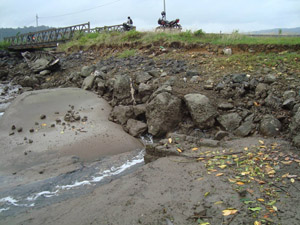
Another glaring example of official apathy is the Kadakachang bridge and sluice gate that was left damaged by the epic disaster. Though a steel bridge was put in place to restore traffic, the base beneath the bridge slipped within months of its installation. But keeping in view the necessity, the bridge though unfit had been kept open, temporarily with small curtain walls on either side of the bridge so that traffic over the bridge could be restricted to pedestrians, two wheelers and light motor vehicles.
A careful look near the bridge area during low tide, unfurled yet another disturbing tale. I was shocked to witness sea water flowing through the mud below the road connecting the RCC and steel bridge. This means during high tide, sea water flows beneath the road from sea to landward side and in the reverse direction during low tide. This is very dangerous because long term removal of mud supporting the road above could result in collapse of the entire stretch of road along with the Kadakachang Bridge and sluice gate all of a sudden!
What is surprising is despite lapse of 6 long years, the Kadakachang bridge is still hanging away from its base and those walls restricting vehicular traffic remains intact as well. Scores of people, two wheelers light motor vehicles etc cross over the precariously placed steel bridge, ignoring the signboard erected nearby which reads : Warning!! Beware of Crocodiles. Perhaps for a common man, the urge to reach the destination (cost effectively) seems more eminent and stronger than the danger lurking beneath their feet.
On the other hand sea water ingress from the defunct Kadakachang sluice gate had converted large tracts of land at Kanyapuram, Stewart Gunj and Wimberly Gunj area into a crocodile sanctuary. Cattle, goats, dogs etc are being devoured by killer crocs regularly. Even human life is not safe in the region. Earlier a crock had attacked a boy, then a woman; both of them had been fortunate to survive the attack on their life. But the killing of Ms Lauren Failla of Morristown and now Mrs Champa Mondol from Tushnabad indicates rising vulnerability of human life in island waters.
Erection of Warning signboard is necessary, but not sufficient. It is a know fact that population of crocs are increasing at an alarming rate, which if not checked immediately would further intensify man-animal conflict situations in the days to come. Secondly the mangrove habitat of salties which has been devastated by the tsunami, every patch needs to be re-grown. Efforts are also required to be made to notify appropriate dumping grounds so that the problem could be tackled effectively.
Till few years back, the islanders had been a mute spectator in the affairs of governance. But with the induction of PRI system and the advent of private news media, social networking sites etc peoples are increasingly voicing their concerns. This has been evident in the CBSE question paper leak episode and repeated in Anna's crusade against corruption. Islands participation in the mass uprising in solidarity with Anna is a pointer to the fact that the islands are no more a passive society. It is a healthy sign, provided the authorities recognize those channels, strengthen them to gain insight into the problems faced by common man.
The Administration has all the means, intellect as well as best working hands at its disposal. It ought to motivate those faculties to fire their cylinders towards providing governance satisfying the needs and aspirations of the common man.
The precariously hanging bridge at Kadakachang and the defunct sluice gate could be set right in a fortnight. Repairing the bridge would facilitate vehicular traffic across the bridge as well as minimize sea water ingress, which eventually would help in tackling the croc menace.
Its high time for the authorities to match words with proactive deeds and curb the dissent brewing among the masses. Relief package based on consensus in a time bound manner is need of the hour. Foot dragging would result in someone rising to the occasion, fit into the shoes of Anna and eventually embarrass the authorities. Anyhow, 6 years has been too long a wait.

PAUPER’S LOG: Ode to Mini India


THE LIGHT OF ANDAMANS | ISSUE 10-11 | 09 SEPTEMBER 2011

PAUPER’S LOG

Ode to Mini India

By Abu Arsh

Our islands since its colonization by the British has developed a society where in people of all class, creed or colour live in perfect harmony. Credit for its genesis goes to the early penal settlers and convicts. The degree of nationalistic pride in them led to a unique language of communication. Its prose lacks grammatical sense but is easily understood by one and all residing in these Islands. Its simplicity and use of words from majority of Indian languages, makes a new entrant to island's society pick up this language in no time. This language has bonded us together since ages and is truly reflected in our melting pot of a culture society.

Politics, lure of economic opportunities and corruption have created avenues in the islands society wherein divisive elements have mushroomed. The sheer power of sacrifices and sufferings endured by our forefathers has contributed in setting up this pluralistic but cohesive society. It has taken a lot to achieve this and should be valued and preserved. Its citizens so far have thwarted all attempts of religious or linguistic polarisation even in the wake several disturbing developments occurring at times. The present crops of young and educated islanders are carrying on the legacy inherited from the founders of these islands 'society with great aplomb. They hang around in peer groups irrespective of their religious backgrounds or other identities. Any social occasion is the time for the entire neighbourhood to get involved and contribute in the celebration. Social networking sites where some of the islanders indulge to communicate with their friends and families or present constructive ideas and even fool around were abuzz with activity. As in the past, this festive season showed great character by members of these sites. Hindus were the first to wish Muslims on Eid, Christians and Muslims were the first to wish Hindus on Janmastami or Ganesh Chaturthi and like wise of other communities too. Some members on far away lands in their posts came up with great recollection of their child hood memories, irrespective of religious identities how they celebrated each others festivals in these Islands. Going through those exchanges gives a feeling of pride being part of such a harmonious society.

The simple and peace loving islanders need to be vigilant and not let divisive elements take us for a royal ride in the pretext of humanity or basic rights. Of late various organisations and individuals are coming with ridiculous ideas. These ideas in garb of preserving particular identities, culture and social service propagate a cult of intolerance and hatred. They try to get people on their side by being advocates of providing better facilities, human rights and opportunities against oppression and injustice. The real intention of such elements is to enhance their own bargaining capacity with power centres in the islands. Islanders should be wary of such so called intellectuals and noble souls. As long as we are united, honest and true to our real life values and principles, we don't need messiahs. Nobody will violate any of our fundamental rights and we will exercise them without any fear or reservation. Our islands don't identify with separatists or antinational sentiments.

Let us all work towards popularizing and conserving this casteless and harmonious culture. As such we don't have much to rejoice with all the muck and corruption deep rooted in our society governed by a detached and unresponsive Administration. New crimes and social problems are on the rise. We should as well be prepared to condemn such acts leading to moral degradation as and when it surfaces in our society. Genuine people and causes which try to bring in positive energy in our society should be appreciated and supported. It wouldn't cost us a dime to be an Andamanian, just be what we have always been- a true citizen of Mini India.

Phoenix Bay Playground: A Victim of Political Game


THE LIGHT OF ANDAMANS | ISSUE 10-11 | 09 SEPTEMBER 2011

Phoenix Bay Playground: 
A Victim of Political Game

By Zubair Ahmed

It is a story of a group of underdogs fighting to protect a playground from the inept administration and shrewd politicians. Since 1970s a two-acre plot situated near fisheries jetty next to PMB office is being used by the residents of Phoenix Bay as playground. They had dreamt of a spacious ground with stadium on the plot. But scheming politicians competing to outdo one another were busily engaged in getting the plot allotted to various departments.
Every two years the residents had to face new challenges. Till recently, they have resisted all attempts by the administration and politicians from snatching their playground from them. Although, the plot was allotted to the Port Blair Municipal Board to develop as a playground, the local politicians got it allotted to various departments just to score some brownie points. An ex-MP even tried to construct a Yatri Niwas, despite a court order banning construction at the site.
 In 1990, the land was allotted to Central Warehousing Corporation for construction of a warehouse. After various representations by organizations and the residents, the order was cancelled in 1993 and allotted to Municipal Council for developing it as a playground. In the order cancelling the warehouse and office building, it is clearly mentioned that the Ministry of Environment and Forests have not allowed any construction on the plots due to its proximity to the sea.


The playground was to be jointly developed by Municipal Council and Education Department. A total estimate of Rs 5,84,000/- was prepared and the work on the playground commenced during 93-94.
But the joy did not last long, when another order came from the administration in 1996 allotting the playground to three departments Port Management Board, Fisheries Survey of India and Directorate of Shipping Services.
 As a last resort, a group of residents from Phoenix Bay area with the help of a local organisation stepped in and filed a case in High Court for intervention on war footing to restrain all concerned departments from any illegal and unlawful construction at the site. The organisation pleaded before the court to consider the 1991 notification issued by MOEF, where it is clearly stated that no new construction of buildings shall be permitted within 200 metres of high tide line. The area was earmarked as a No Development Zone. It also pleaded that the Municipal Council had already spent an amount of Rs 4,68,931/- in the development of the playground. The High Court passed an interim order that no construction should be carried out and all the parties should abide by the result of the application.
Despite the Court Order, on one part of the two-acre plot, Fisheries Survey of India constructed its office building. It is sheer contempt of court, says, P A Salam, a retd executive engineer, who had moved the High Court. But, lack of resources has broken their resolve.
Now, a huge edifice stands on the plot. The vacant land is used as an open stockyard by Harbour Works. However, Salam feels otherwise. “Still the playground can be restored,” said Salam. He blames the local councillors and the MPs for the debacle. Everyone tried to encash the opportunity.
When CPIM had a councillor in the area, he wanted to develop the ground and build a stadium in that area, which irritated the local Congress councillor, who used his clout and machinations and tried his best to resist it and got the plot allotted to various departments.
When the land was allotted to three departments, Bishnu Pada Ray ex-MP too got into the loop and tried his luck. He coaxed the Directorate of Shipping to construct a Yatri Niwas at the site. He used his connections in Home Ministry and got an order issued by P K Jalali, Joint Secretary, MHA for construction of the Yatri Nivas. Based on the order, S Hemachandran, Development Commisssioner on 15 April 2002, asked Chief Engineer, APWD to take immediate action and expedite the project.
When Chief Engineer, APWD sought the possession of the land for construction of the Yatri Nivas, annoyed by the order, on 28 November 2002, Director of Shipping Services  informed the Chief Engineer, APWD that the land was presently under dispute governed by the High Court order of strict ban on new construction. DSS also enclosed a copy of the court order for reference.
Despite the court order, Bishnu Pada Ray even got a Union Minister to lay the foundation stone at the site. The building has not been constructed at the site. But, Fisheries Survey of India went ahead and constructed its office.
On the outset, it seems to be a simple case, but most of the politicians involved had an axe to grind. Ultimately, it is the children of Port Blair, who lost a beautiful playground, which, if developed properly could have provide an alternate to Gymkhana ground.
The lame administration and shrewd political interferences have already paralysed development of sports in these Islands and any hope of its revival will need enormous will power and nerve.

Saturday, September 10, 2011

WEEKLY NEWS DIGEST: Bootlegging Nexus Busted, SHO Ograbraj Transferred

THE LIGHT OF ANDAMANS | ISSUE 10-11 | 09 SEPTEMBER 2011
WEEKLY NEWS DIGEST

Bootlegging Nexus Busted, SHO Ograbraj Transferred

By Staff Reporter

 A bootlegger in the South Andaman village of Manpur under Tusonabad Gram Panchayat was apprehended in the night of 02.09.2011. On a tip off from some vigilant villagers a police team headed by Vineet Kumar DySP,  Bambooflat raided the premises of Gaur, a habitual bootlegger of Manpur. Large quantity of illicit liquor including 7 cases of 750 ml IMFL, a large quantity of country liquor, distilling drums, bags of jaggery, sugar and bark of siris tree were recovered from the premises of the accused. He has been booked under relevant sections of IPC.
According to sources the operation was planned by DySP maintaining high secrecy. The police staff posted at the office of the DySP were included in the raid and the Police Station staffs were not included. Following the raid on 03.09.2011, Station House Officer, Police Station, Ograbraj, Bhoominathan, Sub-Inspector has been stand relieved to Police lines. Sahil Shamsuddin, Sub-Inspector, A&N police will take over as Station House Officer, Police Station, Ograbraj.
Villagers of the area on condition of anonymity told LOA that illicit liquor trade has been flourishing in areas like Chouldari, Namunaghar, Tusonabad, Dundaspoint,  Ferrargunj under the jurisdiction of Police Station, Ograbraj. This has been a major nuisance apart from being a social stigma for the residents of the area. Women complain that entire salaries of men go to the bootleggers as they give credit to these alcoholics. Young men and school children all get hooked to this habit. They blame the nexus of police station staff in flourishing of this illegal trade. 
The raid followed by disciplinary action on the erring officer has given very positive signal to the residents; they are gearing up to report any new cases cropping up in the area. This raid has acted as a confidence building measure between the A&N Police and the local people. The villagers hope that Police will apply sustained pressure in stopping this illicit alcohol trade.

Crocodile Scare in Manpur

In a recent incident on 6th September, a crocodile made way up to a house in Manpur and snatched a duck from the flock before disappearing into the marsh. Wife of Amulya Das resident of Manpur noticed a crocodile just 15 metres away from their house attacking a flock of ducks. People in those areas are scared. Forest department have started responding to the issue. Through public announcements in vernacular languages, people were made aware about the dangers, crocodiles pose in the marsh and submerged areas close to the creeks.

HDFC Bank opens new branch in Port Blair

 HDFC Bank, an Indian-based banking company, has opened its first branch in Port Blair in Andaman Nicobar archipelago.
The company said that the branch will not only cater to the 4-lakh strong local population and the residents of the 37 inhabited islands, it is also set to benefit tourists thronging the tropical islands from other parts of the country as well as abroad with services and products.
Navin Puri, Country Head, Branch Banking, HDFC Bank, said: "As a leading bank of the country, we will continue to conquer new frontiers and take banking to every nook and corner of the country. Opening a branch in Port Blair is the first step towards what we believe will be a long and mutually beneficial partnership."

COVER STORY: Social Corruption: No Takers

THE LIGHT OF ANDAMANS | ISSUE 10-11 | 09 SEPTEMBER 2011

COVER STORY

Social Corruption: No Takers

Steep rise in social crimes - prostitution, rape, suicide, and alcoholism and the indifferent attitude of religious and civil society organisations in tackling the menace is eating into the society.

By Zubair Ahmed

A minor girl from the city is enticed away by a man on promise of marriage and eventually lands in a prostitution racket. She is continuously tormented in a series of shocking crimes and is finally rescued by Police. A 22-year old woman from Diglipur deserted by her husband finds solace in a city brothel. She has a child to feed too. A 20-year old girl from Havelock comes to Port Blair to earn a living and eventually settles for commercial sex work. Poor as her parents are, no one bothers what job she is doing. In both cases, known persons help shed their inhibitions and put them up in these filthy rackets. Gradually it becomes a way of life. "Organized brothels seem to be a new phenomenon here," says ASP Chinmoy Biswal, IPS, whose team recently busted some prostitution rackets. "It shows a rising trend in societies where sudden prosperity comes to some sections while many continue to be in poor economic conditions. It becomes easy for flesh traders of the city to lure women and girls from distant places who are living vulnerable lives." Without much living choices, they fall into it. It's hard to detect prostitution, as astute planning based on solid intelligence is required, which is not always available. The credit for exposing this ugly face of the society goes to the Police department.
CBSE question paper leak exposed another façade of the civilized society, where educated and high profile persons whose children are studying in reputed schools were involved in the racket. Police once again unveiled the shroud and manifested another ugly side of the society. Besides being tickets to seats in medical and engineering  colleges, children's marks in examinations are now 'status symbols' for influential parents who would go to any length to acquire it.
Alcoholism has touched new heights with liquor sale touching a whopping figure of Rs 80 crores last year and expected to reach Rs 100 crores this year. The intrinsic link of alcoholism with other crimes including family feud, broken families, shattered childhood and attempted suicides does not show a bright picture of the society we live in.
Suicides rates are on a steep rise, with four cases reported last couple of weeks, including two policemen and a jawan.
A youth from the Islands was arrested in New Delhi for raping a Finnish woman. Another youth, again from the Islands was held in Bangalore for sexual exploitation of a woman from West Bengal.
Last week, a police officer was relieved from a police station for alleged link with the bootleggers. Another woman, a habitual bootlegger was arrested with 50 litres of illicit liquor from Pathargudda.
It is an open secret that school children in various schools of the city are addicted to substances and prone to alcoholism. A few months back, father of a school child died of heart attack, when he learnt about the indulgences of her daughter.
Nothing prevents two consenting adults from having sex in government guest houses and bathrooms; it is not a cognizable offence either. But when sex of senior government officers moves up from their groins and occupies the space in their brains, it assumes maniac proportion and become a matter for public concern. Even so, if it does not cloud official decisions, it remains within passable limits. But when it starts clouding the official decisions the situation starts going out of hand. A stage comes when the mania not only affects official decisions but also results in squandering public money to entice the gullible 'victims'. Once it reaches that stage, the professional hawks take over and start exploiting the weakness of the man who sits on piles of money and his one signature can move lakhs and lakhs - of taxpayers' money, from the government treasury to their kitty.
Sex in offices is not a new phenomenon by any stretch of imagination. It is used by both the sexes some times, just for pleasure. But the mechanics is not that simple either. There are smart workers who exploit the weakness of their bosses for money, appointment, transfer, relatives' appointment, promotions and; also to get even with rivals in service. Even officers of directors, assistant and deputy director level have many such tales to tell. It is a different matter that they would not say that on record, for obvious reasons.
The malaise has reached a stage where it has started hurting the simple, innocent and hardworking women employees who wish to remain faithful to their husbands and family values. It is being discussed in drawing rooms and in coffee houses; though in hushed tones
These are a few incidents sufficient to gauge the depth of the abyss, the Island society has plunged into.
Economic crimes and corruption is the major contention of the strife between civil society organizations and the government. There were long drawn protests, dharnas and hunger strikes against corruption and black money. People from all walks of life were seen rallying against this scourge.
Social corruption or moral degradation that has made deep inroads into the social polity does not find any takers. Fortunately, police force has been in the forefront in busting not only economic crimes, but tackling social corruption, whereas, it's not their domain. The pro-active police should have opened the eyes of other departments and social organizations and launched a crusade against the evils that is eating into the society.
The rot in the society is visible to the naked eye. Hordes of girls from Diglipur, Havelock and even Little Andaman come to the city for prostitution. Everyone accepts it. Unfortunately, nobody cares about the reason or tries to find out the causes. Even religious organizations, which have presence everywhere too remains indifferent. No visible interventions are made by such organizations. Speaking to LoA, Swami Amritananda, Ramakrishna Mission said that the root cause of social corruption is greed, which cannot be treated superficially. Bishop Alex Dias told LoA that there is lack of information about social issues. He said that the Island lacks credible media, which should highlight the social crimes happening in the society. However, it shows a wide disconnect between such organizations and the society.
P K Mohammed Ali, President, Islamic Guidance Centre said that the common platform created by different religious bodies can be utilized to create awareness about such issues. "Instead of concentrating in Port Blair, programmes can be organized in rural areas too," he added. However, Bishop Alex Dias said that most of the members of Inter-religious Committee show little interest in organizing such programmes.  The committee of Aastha, a body which works among alcoholics has members from all religions. It is also in bad shape without much activity. But, without accountability and fear of God, we cannot expect a major change, he added.
When asked why these bodies does not come out and raise their voice and atleast make express their opinion, he said that political clout and connections are also a reason why there is a tacit silence. However, he accepted the fact that religious organisations can play a major role. Bishop Alex Dias said that the media does not give much importance to religious discourses and even programmes.
Even though large number of people, who came out openly against economic corruption and demanded a strong law to contain financial corruption, civil society organizations and religious organizations must play a major role in creating awareness and also opposing wrong policies of the administration like unscrupulous promotion of liquor trade by issuing licenses to bars without foreseeing the imminent danger.

Treat the Root Cause: Swami Amritananda


The situation is very grim here. I have been in metros like Mumbai and had heard about prostitution rackets and red light areas. It's very unfortunate to know that even such trends have started in these Islands too. Such stigma is always attached with labourers and people with less means, but here the situation is very different. Rich and educated people are involved in such cases.
We have children in our Ashram, where out of 60 children, 50 have single parents. Most of the men have deserted their wives and even women have illicit relationship and abandon the children.
The root cause for all social evils is insatiable greed. Character is totally missing. Or, why people like A Raja are inside jail. Is it because of poverty? Highly educated and qualified people indulge in corruption. Poor and people without resources are caught. Big fries go scot-free.
Question paper leak case is another example of greed. They want their children to get seats that would fetch them economic benefits. Laws and rules are helpless and cannot contain man's greed.

What role can religious institutions play in controlling social corruption?
The objective of education has changed. Today, education is without character. That's the reason, why educated people and those in power are morally and socially corrupt. What can religious institutions do, when people are not interested in transforming themselves? We are trying our best to organize awareness programmes, but ultimately, people should realize the need for change and voluntarily embrace the teachings in their lives, which only a miniscule of the society is willing to do. The result of our work is hardly one percent. Moreover, without treating the root cause, we cannot bring a change superficially. As Swami Vivekananda said - Unless man changes his nature, nothing is possible.

Why do you think religious organizations have failed in bringing the change? Are they themselves corrupt?
There are religious organizations mushrooming everywhere. They too have become money minded. They are also victim of corruption. It is a fact that they too accept donations from corrupt people.

Do you think, poverty and paucity of livelihood options are a reason for increase in social crimes?
I don't think so. What is the definition of livelihood? Who will define the basic needs? It's a relative term. It changes person to person. One who has got five lakh rupees want ten lakh rupees. Absolute greed is the raison d'être for moral and social corruption and the major cause behind increase in crime in the society.

So you say that no kind of intervention is going to work?
I don't believe that we can intervene in somebody's life without their acceptance and consent. We forget our own duties and try to change others, which is not going to help. Earlier, even without scientific advancement and lack of better facilities, people lived content lives. Joint families taught them the virtues of sharing and caring. But, today with the burgeoning of nuclear families, they have become selfish and do not care about others. They are very indifferent towards religious teachings. If moral and value education is made must in educational institutions, there might be gradual change in this attitude.

The Police have been to an extent successful in curbing social crimes too.
You are right. If there is a violation of rules and regulation, action can be taken. What about ethics? If somebody ignores the ethical part of their job, how can you prevent it? Citizen charter is fine, but there should be will and moral principles, which is absolutely missing. Is it not a corrupt practice if someone overlooks the sense of duty and responsibility?

Lack of Information about Social Issues a Major Impediment: Bishop Alex Dias


What do you think about increase in social crimes in the Island society?
We are not aware about increase in social and moral corruption. There is no credible media in the Islands, which brings forth such issues. Media has an active role in highlighting such issues. This Islands lack responsible media, which can conscientize the society about social issues. But there is a wide divide because of lack of information.

Your take on the rot in education system, especially in the wake of CBSE question paper leak?
The role of education is transmission of right values. If it does not happen, children will become bloodsuckers. We are trying our bit to imbibe moral values in children through value education in our schools. If we fail in transmitting it, we will close our institutions.
Unfortunately, we are not the only teachers today. Media like television too play a major role in the education of today's children, which is very unfortunate. We have to struggle a lot.
The CBSE question paper leak was a shocking incident. When I was a child, my parents would not have tolerated such an incident. Sadly, parents are involved in such heinous acts.

Do you think religious organizations can play a major role in bringing a change?
Yes, religious organizations can play a major role and we are doing our bit. Unfortunately the awareness level is very low. We have been working among the Catholics in curbing the scourge of alcoholism, which is very rampant. There is a lot to be done.